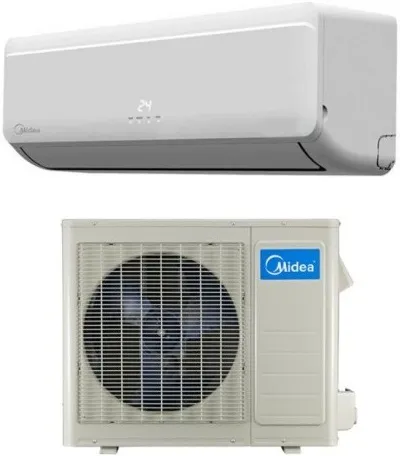
Midea Air Conditioners in Singapore: Complete Guide
Midea has become a major global name in home appliances and air-conditioning products, with a particularly broad product portfolio.
One of Midea's biggest advantages is scale.
The company operates across residential and commercial HVAC categories, giving customers access to wall-mounted split systems, multi-split products, portable air conditioners, cassette units, ducted systems, VRF solutions, and larger commercial HVAC technologies.
For Singapore buyers, Midea can be especially attractive because it offers a balance between technology, product variety, energy efficiency, and value.
It is a brand worth considering when the buyer wants modern features without automatically moving into the highest premium price category.
Why Choose Midea Air Conditioners?
Midea's strongest advantage is choice.
A user looking for air conditioning does not always need the same type of system.
One person may need:
- A small bedroom AC.
Another may need:
- A multi-room system.
Another may need:
- A portable unit.
A business may need:
- Cassette or ducted cooling.
A larger building may require:
- VRF or centralised HVAC.
Midea's broad portfolio allows the brand to address these different situations.
### Midea is attractive for users who want:
- Competitive pricing.
- Inverter technology.
- Smart-home functions on selected models.
- Portable and split systems.
- Multi-split flexibility.
- Commercial HVAC solutions.
- Modern air-cleaning technologies.
- A wide selection of capacities.
Midea is therefore often a practical middle-ground option.
It does not rely only on premium branding, and it does not have to compete only through the lowest possible price.
Types of Midea Air Conditioning Systems
### 1. Midea Wall-Mounted Split Air Conditioners
Wall-mounted split systems are suitable for:
- Bedrooms.
- Living rooms.
- Study rooms.
- Home offices.
- Small commercial spaces.
They are among the simplest and most common configurations.
### 2. Midea Portable Air Conditioners
Portable models provide a solution for rooms where permanent installation is difficult.
They can be useful for:
- Rental properties.
- Temporary spaces.
- Home offices.
- Bedrooms.
- Rooms with installation restrictions.
### 3. Midea Multi-Split Systems
Multi-split systems allow several indoor units to connect to a shared outdoor system.
This is useful for:
- Multi-bedroom homes.
- Condominiums.
- Larger residences.
- Small offices.
### 4. Midea Cassette Air Conditioners
Cassette systems are designed for ceiling installation and broad air distribution.
They can be used in:
- Offices.
- Restaurants.
- Shops.
- Meeting rooms.
- Commercial areas.
### 5. Midea Ducted Systems
Ducted air conditioning is useful when users want the system to remain mostly hidden.
It can distribute air through ceiling outlets while keeping the interior visually cleaner.
### 6. Midea Floor-Standing Systems
Floor-standing units can be useful where high airflow is needed or ceiling/wall installation is inconvenient.
### 7. Midea VRF Systems
Midea's commercial HVAC portfolio includes VRF solutions.
These are suitable for larger buildings and multi-zone installations where multiple indoor units need to be managed as one overall system.
Energy Efficiency: Midea Air Conditioners
Midea uses inverter technology across many of its modern air-conditioning products.
The basic principle is the same as other inverter systems.
The compressor does not always operate at maximum capacity.
Instead, it adjusts output according to demand.
### Why This Is Important
Suppose a room needs 100% cooling when the air conditioner first starts.
After reaching the desired temperature, perhaps only 40% or 50% of the original cooling capacity is required.
An inverter compressor can reduce its output.
This provides several advantages:
- Better temperature stability.
- Lower unnecessary cycling.
- More efficient long-term operation.
- Potentially lower electricity consumption.
- More comfortable cooling.
### Midea's AI Energy Management
Selected Midea smart air conditioners use AI-related functions to analyse operating conditions and help reduce energy consumption.
Depending on model and market, connected features can provide information about energy usage and allow users to manage operation remotely.
This makes Midea more competitive with brands that traditionally position themselves around smart-home technology.
What Technology Makes Midea Air Conditioners Different?
Midea's technology portfolio is broad rather than centred around one single signature feature.
### Inverter Quattro Technology
Selected Midea air-conditioning systems use inverter technologies designed to provide efficient and responsive compressor control.
The objective is to maintain room temperature without unnecessary full-power operation.
### AI EcoMaster
Selected Midea systems feature AI EcoMaster technology designed to optimise cooling and energy consumption.
The system can analyse cooling requirements and adjust operation to reduce unnecessary power use.
### Breezeless Cooling
Midea's Breezeless technology focuses on distributing air through many small outlets to reduce the sensation of direct cold airflow.
This concept is similar in purpose to other draft-reduction technologies but uses Midea's own airflow design.
### SmartHome / App Connectivity
Midea's smart air-conditioning models can connect with mobile applications and smart-home ecosystems on supported products.
Users can control settings remotely and manage schedules.
### PrimeGuard / Air-Quality Technologies
Selected Midea systems incorporate air-quality technologies, filters, and antibacterial or self-cleaning functions.
The exact implementation differs between model families.
### Self-Cleaning
Many Midea air conditioners include cleaning functions that can help reduce contamination on the indoor heat exchanger.
Some systems use a freeze-cleaning cycle.
The heat exchanger is cooled until frost forms, then the frost melts and helps wash away accumulated contaminants.
Core Innovations and Technologies Highlights
| Midea Technology | Main Purpose | Practical Benefit |
|---|---|---|
| Inverter Technology | Adjusts compressor output | Better efficiency and temperature control |
| AI EcoMaster | Optimises cooling operation | Helps reduce energy waste |
| Breezeless | Distributes air through multiple outlets | Softer airflow |
| SmartHome Connectivity | Remote control and monitoring | Convenient operation |
| Self-Cleaning | Helps clean indoor heat exchanger | Supports internal hygiene |
| Freeze Cleaning | Uses ice and water to flush contaminants | Helps maintain coil cleanliness |
Midea's Strongest Advantage: Product Variety
Midea's product breadth is one of its biggest strengths.
Imagine two customers.
### Customer A
A tenant needs one bedroom cooled during the night.
A portable Midea system may be enough.
### Customer B
A homeowner has four bedrooms and wants independent control.
A multi-split system may make more sense.
### Customer C
A restaurant needs broad ceiling airflow.
A cassette system could be appropriate.
### Customer D
An office building requires multiple zones.
VRF becomes a possible solution.
The same brand can potentially cover all four scenarios.
This is a practical advantage for installers, developers, property owners, and customers who want a consistent HVAC ecosystem across different applications.
Maintenance and Longevity
Midea systems still need routine servicing.
The basic maintenance schedule should include:
- Filter cleaning.
- Evaporator coil cleaning.
- Outdoor condenser cleaning.
- Drainage inspection.
- Refrigerant checks.
- Electrical checks.
- Fan and blower inspection.
- Airflow testing.
### Self-Cleaning Is Helpful, But Not Magic
Self-cleaning technology can help keep the indoor heat exchanger cleaner.
However, it does not automatically clean:
- Every part of the blower.
- Drainage pipes.
- Outdoor coils.
- Electrical components.
- Refrigerant circuits.
Therefore, professional servicing remains necessary.
### Midea Portable AC Maintenance
For portable units, pay particular attention to:
- Filters.
- Exhaust hose.
- Window sealing.
- Condensate drainage.
- Air intake.
- Exhaust outlet.
The portable unit must be able to remove hot air effectively.
If the exhaust hose is badly positioned, cooling efficiency can suffer.
Compare: Midea vs Other Air Conditioner Brands
| Factor | Midea | Samsung | LG | Toshiba |
|---|---|---|---|---|
| Product variety | Excellent | Strong | Excellent | Strong |
| Value positioning | Strong | Mid to premium | Mid to premium | Mid to premium |
| Smart-home features | Strong on selected models | Excellent | Excellent | Moderate |
| Inverter technology | Strong | Strong | Strong |
Midea is especially attractive when the buyer wants a modern feature set without automatically paying premium-brand pricing.
Who Should Choose Midea Air Conditioners?
Midea is a good choice for:
- Budget-conscious homeowners.
- Families installing multiple rooms.
- Users who want inverter efficiency.
- Smart-home users who want connected control.
- Tenants looking for portable cooling.
- Small offices.
- Shops.
- Restaurants.
- Developers and property managers.
- Commercial projects requiring multiple HVAC configurations.
It is particularly useful for customers who want to compare several system types before deciding.
How to Choose the Right Midea Air Conditioner
### 1. Determine Your Budget
Set the total budget rather than only the purchase price.
Include:
- Installation.
- Piping.
- Electrical work.
- Brackets.
- Drainage.
- Future maintenance.
### 2. Calculate Cooling Requirement
Consider:
- Room size.
- Ceiling height.
- Sun exposure.
- Occupancy.
- Windows.
- Appliances.
- Insulation.
### 3. Choose the System Type
Use a wall-mounted split system for normal residential rooms.
Choose portable cooling where permanent installation is difficult.
Use multi-split for several rooms.
Choose cassette or ducted systems for larger spaces.
### 4. Decide Whether Smart Features Matter
If you want:
- Smartphone control.
- Scheduling.
- Energy monitoring.
- Smart-home integration.
then select a model that explicitly supports these functions.
### 5. Compare Energy Performance
Look at the actual energy rating of the model.
A cheaper air conditioner is not always cheaper to own.
### 6. Check Noise
For bedrooms, check the indoor-unit sound specification.
### 7. Consider Service Support
Before purchasing, verify:
- Warranty.
- Spare parts.
- Service availability.
- Installation support.
A Different Point: Midea Is a "System Choice" Brand
Some brands are strongly associated with a particular type of customer.
For example:
- One may be known for smart-home technology.
- Another may be known for Japanese engineering.
- Another may be known for commercial HVAC.
Midea is different because it can be viewed as a system choice brand.
Its biggest strength is the ability to select from different configurations without moving immediately into a premium price category.
That makes it particularly useful for:
- Property developers.
- Renovation projects.
- Multi-room homes.
- Landlords.
- Commercial operators.
The brand gives customers more flexibility to match the product to the property.
Pros and Cons Analysis
| Pros | Cons |
|---|---|
| Broad range of air-conditioning products | Technology differs significantly between models |
| Strong value proposition | Premium competitors may have stronger brand positioning |
| Inverter models widely available | Smart features depend on the specific model |
| Portable options available | Portable ACs can be noisier than split systems |
| Multi-split options | Multi-split installation requires careful planning |
| Cassette, ducted and VRF solutions | Larger systems require professional design |
| Smart connectivity on selected products | App features may require compatible network conditions |
| Self-cleaning technologies available | Self-cleaning does not eliminate professional servicing |
Midea for Budget-Conscious Homeowners
Midea is particularly worth considering when several rooms need air conditioning.
For example, imagine a four-bedroom home.
Buying the cheapest unit for each room may initially appear attractive.
But the better calculation is:
Initial cost + installation + electricity + servicing + replacement cost.
An efficient Midea multi-split configuration could potentially offer better overall value than buying multiple low-cost units without considering long-term operating expenses.
This is why Midea should not simply be categorised as a "cheap AC brand."
Its broader product portfolio includes technologies designed for efficiency, smart management, multi-zone cooling, and commercial applications.
Conclusion: Is Midea Air Conditioner a Smart Investment?
Midea can be a very smart investment for buyers who want choice, practical technology, competitive pricing, and flexible air-conditioning configurations.
Its biggest advantage is not one single feature.
It is the ability to cover a wide range of cooling requirements:
portable → split → multi-split → cassette → ducted → VRF.
That range makes Midea especially attractive for homeowners, landlords, businesses, and developers who need different cooling solutions for different spaces.
Midea may not always offer the same premium positioning as some Japanese or high-end smart-home brands, but that is not necessarily its weakness.
For many buyers, the goal is not to own the most expensive air conditioner.
The goal is to get the right cooling performance, reasonable energy consumption, useful features, dependable installation, and manageable long-term cost.
That is where Midea can make a strong case.
Choose the right capacity, compare the exact model's efficiency and features, invest in proper installation, and maintain the system regularly.
When those factors are handled correctly, Midea offers a practical balance between technology, flexibility, and value.